SnowPlow.TV / PRACTICAL GUIDE
How Retail Plazas Coordinate Snow Clearing Between Tenants
Who clears what in a multi-tenant retail plaza? How landlords, property managers and tenants split lots, walkways and city sidewalks in BC.
 SnowPlow.TV
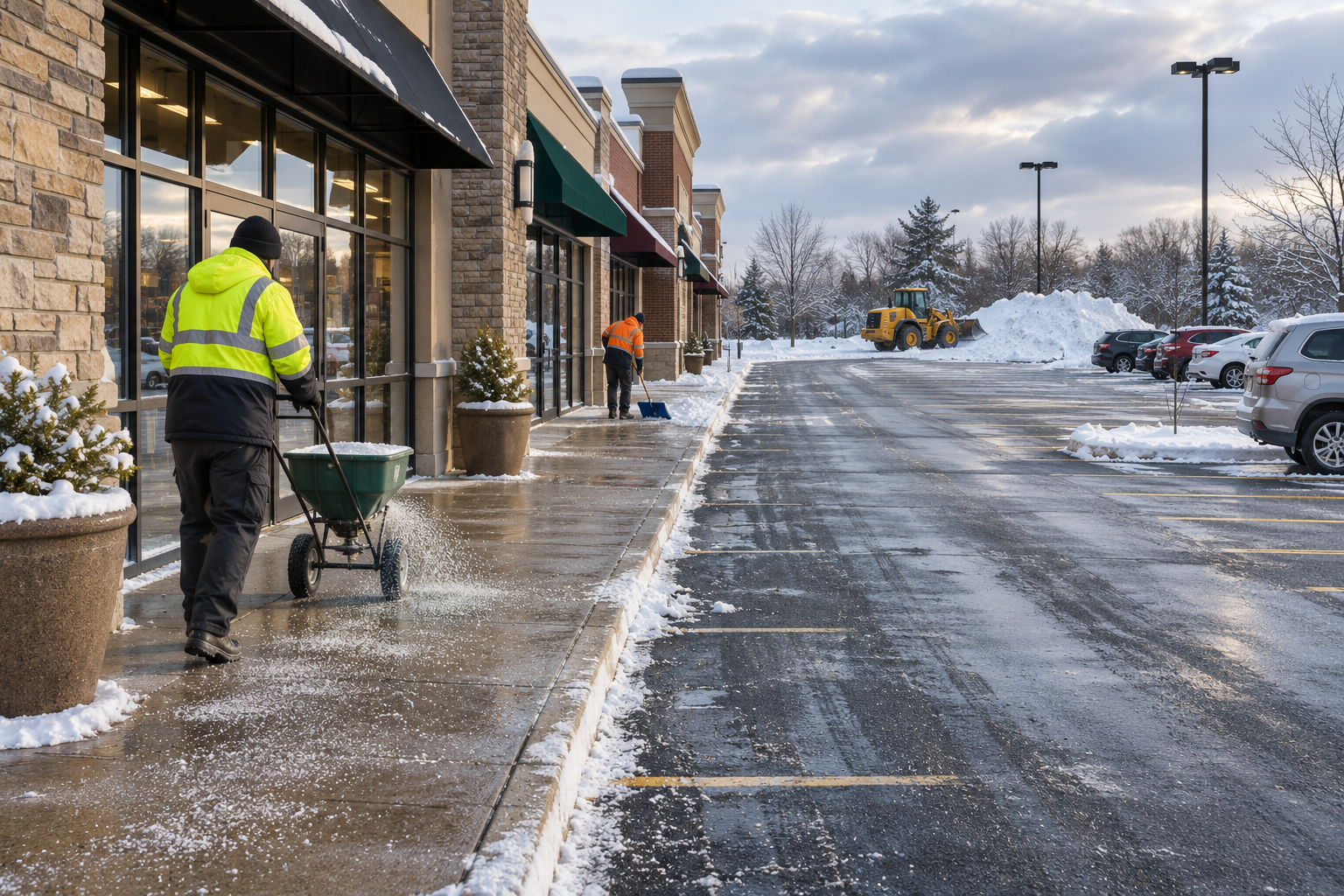
Retail plazas coordinate snow clearing best when one party, usually the landlord or property manager, runs a single snow contract for the parking lot, drive aisles and shared walkways, and the lease spells out exactly which areas individual tenants handle, such as their own entrance or a patio. Everyone then works from the same site map, the same timing and the same communication plan. That matters in BC because the Occupiers Liability Act puts a duty of reasonable care on whoever occupies or controls the premises, and Vancouver's guidance requires owners and occupants to clear adjacent public sidewalks by 10 a.m. Overlapping or missing assignments create avoidable gaps; a coordination plan should expose them before service begins.
Why plazas are tricky
A single-tenant building has one decision-maker. A plaza has a landlord, sometimes an outside property manager, a snow contractor and a dozen businesses with different hours. Common gaps include:
- The contractor clears the lot overnight, but nobody de-ices storefront walkways before a 7 a.m. coffee shop opens.
- Tenants shovel their doorways onto areas the contractor already cleared.
- The public sidewalk along the street is assumed to be "the city's."
- Delivery areas and garbage enclosures behind the units are missed entirely.
Who's responsible under BC law
The occupier's duty
Section 3 of BC's Occupiers Liability Act says an occupier must take the care that, in all the circumstances, is reasonable to see that people and their property on the premises are reasonably safe. In a plaza, more than one party can be an occupier of different areas: the landlord controls the common areas, while each tenant occupies its own unit and often its entrance.
The Act also deals with two situations directly relevant to plazas. Section 5 addresses occupiers who hire independent contractors, and section 6 addresses landlords where premises are leased and the landlord is responsible for maintenance or repair. Do not assume hiring a contractor resolves every responsibility. Obtain advice on the actual control, lease and service arrangements.
Read the lease alongside the operating plan
A lease can allocate maintenance tasks and costs, but a property manager should not treat a short article as a legal interpretation of that lease. Ask qualified advisers to review unclear responsibilities. Then translate the agreed allocation into a map and contact list that the actual contractor and tenants can use. A clause nobody sees during a storm is an incomplete operating arrangement.
Confirm the municipality for the actual address
For a Vancouver plaza, the City's current winter maintenance page identifies the adjacent-sidewalk requirement and its 10 a.m. deadline. Do not assume every municipality uses identical wording, coverage or enforcement. Verify the address and current rule before placing a deadline in the contract.
The public sidewalk is only one part of a plaza's circulation. A municipal deadline does not replace decisions about private entrances, accessible routes, loading areas or conditions that change later. Keep legal requirements, lease allocations and the contractor's agreed service terms identifiable as separate parts of the plan.
Build a responsibility map
The most useful document a plaza can have is a one-page snow map, shared with the contractor and every tenant. Colour-code who handles each area:
| Area | Typical owner of the task | Notes |
|---|---|---|
| Parking lot and drive aisles | Landlord's contractor | Set trigger depth and timing in the contract |
| Main walkways along storefronts | Landlord's contractor, or tenant per lease | Decide clearly; this is where slips happen |
| Tenant entrance and first few metres | Often tenant | Include de-icing, not just shovelling |
| Patios and private seating | Tenant | Usually tenant-controlled |
| Public sidewalk along the street | Landlord or tenants per lease | Must meet the city's morning deadline |
| Loading and garbage areas | Landlord's contractor | Coordinate with delivery schedules |
| Snow pile locations | Landlord and contractor | Away from entrances, drains and sightlines |
Set timing around opening hours
Plaza tenants rarely open at the same time. A gym or coffee shop may open hours before a clothing store. Give your contractor a list of tenant opening times and ask them to sequence work accordingly:
- Drive entrances and fire lanes
- Walkways in front of early-opening tenants
- The rest of the storefront walkways
- Parking rows, starting nearest the entrances
- Rear service areas
Ask for return visits during the day if snow continues, and for de-icing of walkways before the evening freeze.
Communicate before and during storms
- Before the season: send tenants the snow map, contractor contact procedure and their own responsibilities. Remind them not to shovel onto cleared areas or into drive aisles.
- Before a storm: a short notice to tenants with expected contractor timing.
- During a storm: one contact person at the property manager for problem reports, with photos.
- After a storm: log what was cleared and when. That record matters if there's a slip claim later.
Recovering costs fairly
Some plaza leases provide for recovery of snow and ice costs through common-area charges; check the actual lease rather than assuming that arrangement applies. Tenants get better value when the contract is clear about what's included, such as walkways and sidewalks, so they aren't paying twice for their own staff to do the same work. Review the arrangement each fall with tenants' feedback from the previous winter.
A quick plaza snow checklist
- One snow map, shared with everyone
- Lease clauses that name who clears entrances, walkways and city sidewalks
- Contractor timing tied to tenant opening hours
- De-icing included, not just plowing
- A single contact for problems during a storm
- A written log of service visits
Map the handoffs, not just the coloured areas
A boundary line can leave an awkward strip that neither crew considers its job. At a storefront, identify where the common walkway meets the tenant-controlled threshold. At a parking stall, identify the pedestrian route between the vehicle and the entrance. Walk through those transitions with the people responsible for them rather than assuming colours on a drawing meet neatly in reality.
Give every task an accountable contact, a service provider and a reporting route. The person approving the work may be different from the person performing it. Record who checks an area after completion and who can request a return. Avoid a plan in which every tenant can dispatch the same contractor independently without informing the manager.
A responsibility matrix should also identify cover when a business is closed. If a tenant normally handles an entrance but closes for a holiday, the plaza still needs an agreed arrangement for the affected route. Do not assume an employee will appear because their business usually opens at a particular time. Confirm changes and communicate them to the coordinator.
Use opening hours as information, not the only priority
An early-opening café is a useful planning input, but opening time alone cannot determine the entire sequence. Emergency access, accessible pedestrian circulation, active work zones and safe movement of equipment also need review. The manager and contractor should assess the actual property and identify conflicts before fixing a route.
Record deliveries, waste collection and any recurring movement of large vehicles. If a delivery blocks an area during a planned attendance, the work may need a revised sequence or a return. Agree how that change is reported and authorized. A schedule that depends on a permanently empty loading bay should not be treated as confirmed unless the plaza can maintain that condition.
Tenant staff can help by reporting obstructions and changed hours through one channel. They should not direct equipment into an unassessed area or stand in its path to request a quick extra pass. Include plain communication instructions in the tenant notice and identify who handles an urgent pedestrian hazard while the main contact is unavailable.
A hypothetical event shows where coordination fails
Consider an invented small plaza with a bakery opening early, a clinic opening later and a rear delivery area. This example describes planning decisions, not a real property or a recommended universal route. The map identifies a shared front walkway, individual thresholds, public frontage and the rear service route. The agreement assigns each area rather than assuming every tenant has the same lease.
Before a forecast event, the manager confirms the bakery's opening time and a scheduled delivery. The contractor reviews the service plan and explains any access conflict. The clinic reports that a temporary barrier changes its usual entrance. The coordinator updates the working map and sends one version to everyone affected, so the crew does not arrive with yesterday's assumptions.
During attendance, a parked vehicle prevents completion of one section. The service report records the obstruction and the coordinator receives the notice. The manager arranges the appropriate next step under the agreement rather than marking the whole plaza complete. Later, a tenant reports a new slippery patch. That is logged as a new observation, not dismissed because an earlier photograph showed a clear walkway.
After the event, the manager checks whether the map, contact list and access arrangements worked. The review may reveal a communication problem rather than a need for more equipment. This sequence demonstrates the value of coordination: the parties can identify what happened, what remains open and who must act next.
Agree where removed snow can go
Snow storage is a site-planning question. A pile location that appears convenient for machinery may interfere with visibility, pedestrian travel, accessible parking, drainage or another tenant's operation. Identify proposed locations during the site assessment and have the relevant parties approve them. Do not presume that an unused-looking corner belongs to the plaza or can accept snow.
Discuss how the plan changes when a storage area is unavailable or reaches the practical limit assessed for the site. If hauling may be required, identify the approval and charging process. A manager should not discover that an essential extra has no agreed decision-maker while the contractor is already waiting.
Melting and refreezing can create a different problem from the original accumulation. The contractor should report observations within its scope, and the manager should arrange appropriate assessment of recurring drainage or building issues. Snow service should not be advertised as a permanent repair for a leaking pipe, damaged surface or drainage defect.
Keep inspections separate from promises of permanent safety
A service record describes an attendance at a time and place. Weather, traffic and runoff can change the surface afterward. Agree what monitoring or return attendance is included and what is expected from occupants between visits. Avoid wording that turns one completed clearing into an assurance that every surface stays free of hazards for the rest of the day.
Ask tenants to report the exact area and observation. A description such as ice beside the west entrance is more useful than the lot is terrible. Where safe and appropriate, a photograph can help the coordinator locate the problem. Staff should not enter an active equipment zone or stand beneath overhanging snow to obtain an image.
A recurring problem needs a retained history. Record when it was observed, what was done and whether a building or drainage assessment was requested. This prevents the same issue from being treated as a new unexplained complaint at every event. It also gives the manager useful information when renewing the service agreement.
Protect the credibility of service documentation
Use property identifiers, timestamps and clear descriptions. A generic completed checkbox can conceal missed thresholds or an inaccessible rear route. Records should distinguish completed work, observed conditions, requested extras and unresolved areas. If the contractor did not inspect an area, the report should not imply otherwise.
Keep photographs relevant and handle personal information sensibly. A wide image can show the overall location, while a closer view may identify the specific work. Neither should be reused as evidence for a different day. Do not alter a report to make an incomplete visit appear complete; correct errors through a retained update with an explanation.
Agree who stores records and how the manager obtains them. The retention arrangement should fit contractual, insurer and legal advice rather than an invented universal number of years. If an incident occurs, preserve the actual records and follow the applicable reporting process. The article's coordination suggestions are not a conclusion about responsibility for any claim.
Resolve billing disputes against the agreed map
When two parties believe they paid for the same area, begin with the lease, contract and service map. Confirm whether one fee covered common work and another covered a separate threshold task. Do not assume duplication from invoice titles alone. Conversely, do not dismiss a tenant's concern merely because the contractor attended the property.
Have a process for reviewing additional visits and extras. The invoice should connect to the agreed counting rule and authorizations. If a return was needed because access was blocked, retain that explanation. If the written scope was ambiguous, resolve the immediate issue and correct the next version rather than relying on another verbal understanding.
Keep the plan current through tenant changes
A vacant unit becoming a late-night business can change pedestrian demand and contact arrangements. Construction, changed delivery times and a new property manager can also make a previously useful plan stale. Set a practical review point and a named person responsible for issuing updates. Remove obsolete contact details from the working copy.
A coordinated plaza does not depend on everyone remembering last winter's conversation. It uses a current map, verified responsibilities, credible service terms and a clear way to report new conditions. Those are operational tools for keeping independent tenants and contractors working from the same information when the weather changes.
Test the contact chain before the season
Ask each listed contact to confirm the number and the role they will cover. Check how messages move from a tenant to the coordinator and then to the contractor. This is a communication rehearsal, not a staged claim of snow-service performance. Replace inactive contacts and agree a backup so a report does not sit unanswered in a closed office.
At a mid-season review, ask whether any tenant has changed its use of shared space. A temporary display, outdoor queue or construction enclosure may change how pedestrians reach a door. Have the responsible parties assess the effect and update the map where necessary. Do not let an old attachment remain the working instruction simply because it was correct when the contract was signed.
Frequently asked questions
Who coordinates retail plaza snow clearing?
Assign a named coordinator, usually the property manager or another authorized party, and verify the lease and contract responsibilities for each mapped area. Do not assume every tenant has the same arrangement.
Does hiring a contractor automatically remove an occupier's responsibility?
No automatic transfer should be assumed. BC's Occupiers Liability Act addresses occupiers, independent contractors and landlord responsibilities. Obtain advice on the actual facts and agreement.
What belongs on the snow map?
Include common circulation, storefront thresholds, public frontage, accessible routes, loading areas, agreed storage locations and the handoffs between responsible parties.
Does a completed visit mean the plaza stays clear all day?
No. Conditions can change after attendance. Agree monitoring, reporting and return-service arrangements, and record new observations rather than treating an earlier photograph as a permanent assurance.